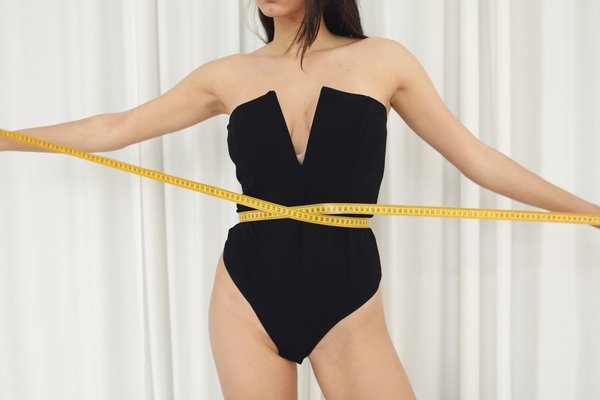
A mirror can give you an impression of your silhouette, but clothing, posture and camera angles can change what you see. A few consistent measurements offer a more useful starting point. This body shape measurements guide explains how to measure yourself at home and interpret the differences without forcing your body into a rigid label.
Set up for accurate measurements
Use a flexible dressmaking tape, a mirror and somewhere to record your numbers. Centimetres are convenient in the UK, although inches work equally well if you stick to one unit. Measure over underwear or light, close-fitting clothes; bulky fabric changes the result. If possible, ask someone to help with your shoulders.
Stand upright with weight evenly balanced, shoulders relaxed and arms down. Keep the tape flat against your body without digging into the skin. For circumference measurements, check in the mirror that it runs horizontally around your back. Take each reading twice and repeat it if the figures differ noticeably.
How to measure shoulders, bust, waist and hips
Shoulders: record width, not just a visual impression
For shoulder width, locate the outer bony tip of each shoulder, where the shoulder meets the upper arm. Have a helper measure across your upper back from one point to the other, following the natural line rather than pulling the tape tight. Record the measurement in centimetres.
Some body shape calculators instead ask for shoulder circumference, measured around the broadest part of both shoulders and upper arms. These are different measurements. Never compare a shoulder width directly with your bust or hip circumference, or enter one when a calculator requests the other.
Bust: measure the fullest point
Wrap the tape around the fullest part of the bust or chest and across the back at the same level. Keep your arms relaxed and breathe normally. The tape should touch the body without compressing it. If you normally wear a bra with your outfits, a smooth, non-padded everyday bra can help you record a useful clothing-fit measurement.
Waist: find your natural crease
Your natural waist is not necessarily where jeans sit or exactly at your navel. Bend gently to one side: the crease that forms helps you find the waistline. Straighten up, relax your abdomen and place the tape around that point. Breathe out normally, but avoid sucking in your stomach.
If the narrowest-looking part of your torso and the bend crease differ slightly, choose one clearly defined point and use it consistently. Fashion measurements and medical waist measurements may use different landmarks, so do not mix their methods.
Hips: include the fullest part of the seat
Stand with your feet comfortably close together and wrap the tape around the widest part of your hips and bottom. This point may sit lower than your hip bones. Turn sideways to check the tape has not ridden up at the back, then read the number without pulling inward.
If trousers often feel tight across your lower hips, you can also record a high-hip measurement just below the waist. Keep it separate from the full-hip figure; most basic bust waist hip measurements use the fullest hip circumference.
Read the proportions rather than chasing a perfect category
Once you have the numbers, compare bust and full hips first. Are they fairly close, or is one noticeably larger? Next, look at how much smaller your natural waist is. These differences can suggest a balanced silhouette, more volume through the hips, more volume through the upper body or a straighter outline.
Descriptions such as hourglass, pear, inverted triangle and rectangle are useful shorthand, not precise scientific classifications. Different style guides set different cut-offs, and measurements close to a boundary may fit more than one description. Shoulder width adds context, but it cannot be compared numerically with body circumferences.
For a closer look at styling choices, a guide to pear-shaped outfits or an hourglass dressing guide can be more helpful than repeatedly retaking the tape measurements. Use whichever advice solves an actual fit problem.
A worked example you can copy
Imagine you record a bust of 94 cm, waist of 76 cm and full hips of 100 cm. The hips measure 6 cm more than the bust, while the waist is 24 cm smaller than the hips. That points towards a defined waist with somewhat fuller lower-body proportions, but it does not prove a single body-shape label.
Write the figures as “94 / 76 / 100 cm”, add your shoulder measurement separately and date the entry. When buying trousers, the 100 cm hip figure may matter more than the category name. When choosing a fitted dress, both bust and hip measurements will matter.
Avoid small errors that create misleading results
The most common problem is inconsistency, not an imperfect body. Measuring the waist at the waistband one week and at the natural crease the next can produce two different answers. So can measuring hips over a thick skirt or pulling the tape more tightly on a second attempt.
Turn your measurements into better clothing decisions
Body proportions can help explain why two garments with the same size label fit differently. A blouse may suit your bust but pull across the shoulders; jeans may fit the waist but need extra room through the seat. Compare your actual measurements with each retailer’s size chart, then check garment cut and fabric stretch.
If you are exploring different silhouettes, try a guide to balancing shoulder and hip proportions. Treat suggestions as experiments: comfort, preferred fit and personal style matter more than obeying a rule for a named shape.
Frequently asked questions
Can I measure my body shape by myself?
Yes. A mirror and flexible tape are enough for bust, waist and hip circumferences. Shoulder width is easier with another person, because reaching across your back can shift the tape and distort the reading.
Should I measure in centimetres or inches?
Either is fine. In the UK, centimetres are common on measurement charts, but the important thing is using the same unit for every figure. Do not combine a centimetre waist reading with an inch hip reading.
What if I fall between two body shapes?
That is normal. Labels depend on the guide’s definitions, and bodies do not follow fixed templates. Focus on which garments fit your shoulders, bust, waist and hips rather than choosing a category at all costs.
Are body shape measurements the same as clothing size?
No. Measurements describe your body; clothing sizes are set by brands and vary with design and intended ease. Check the specific product’s size chart and consider its stretch and cut before ordering.
Keep a useful record, not a rigid label
Accurate body shape measurements start with repeatable technique: level tape, relaxed posture and consistent landmarks. Save your figures, compare them thoughtfully and use them to understand how clothes fit. Your measurements should make getting dressed easier, not limit what you feel able to wear.